
Blog

A worker at a hospital notices a colleague billing Medicare for procedures that never happened. A government contractor's employee finds falsified test records on equipment headed for military use. In moments like these, the person who noticed the fraud often has more legal standing than they may realize.
Congress passed a federal law known as the False Claims Act to protect government funds from fraud, allowing private individuals to sue on behalf of the United States when they have original evidence that a person or company has defrauded a federal program. This type of lawsuit is known as a qui tam action, derived from a Latin phrase describing someone who pursues a claim both for the sovereign and for their own benefit.
The law refers to the person bringing this type of suit as a relator — a term used throughout this guide for the whistleblower-plaintiff at the center of these cases. Among its provisions, the act includes a whistleblower reward structure that shares a portion of any recovery with the relator. In fiscal year 2025 alone, whistleblowers filed 1,297 qui tam suits, a record high, while total settlements and judgments under the act exceeded $6.8 billion, the highest figure in the law's history.
Understanding how a case moves from attorney consultation through government investigation to resolution can help a prospective relator know what to expect at each stage.
The Qui Tam Lawsuit Process
While the specific facts vary by case, the False Claims Act lays out a procedural framework that governs how a qui tam lawsuit unfolds from the moment a relator decides to come forward.
1. Consult a Qui Tam Attorney
A relator brings a qui tam lawsuit under 31 U.S.C. § 3730(b), and federal courts have consistently held that an attorney must represent relators, since the underlying claim ultimately belongs to the government, rather than to the relator personally.
Once you have chosen a qui tam attorney, your initial conversation should be protected by attorney-client privilege. This allows prospective relators to discuss their evidence confidentially before moving their case forward.
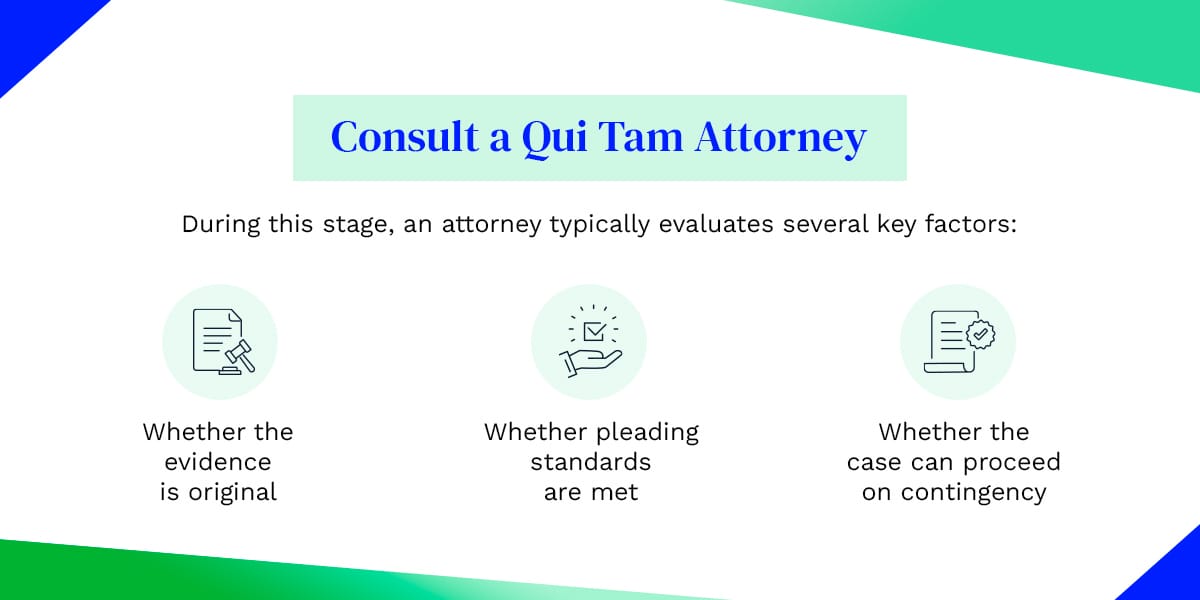
During this stage, an attorney typically evaluates several key factors:
- Whether the evidence is original: The relator's evidence must be non-public and not already known to the government through other sources.
- Whether pleading standards are met: Because fraud claims require greater factual detail under federal procedural rules, a complaint must describe the alleged scheme with enough specificity to meet that standard.
- Whether the case can proceed on contingency: Qui tam cases are generally handled this way, meaning a relator does not pay up front legal fees to pursue a claim.
2. File Your Complaint Under Seal
Many prospective relators worry whether their employer will learn of a complaint before they are ready to proceed. Under the False Claims Act, a qui tam lawsuit is filed under seal, meaning it remains confidential in federal district court and is not served on the defendant. Only the assigned judge and Department of Justice (DOJ) representatives review it at this stage.
Alongside the complaint, a relator must also serve a written disclosure of material evidence on the Attorney General and the relevant U.S. Attorney. By statute, the seal period lasts at least 60 days, though courts routinely grant extensions for good cause, and in practice, many qui tam lawsuits remain under seal far longer than that minimum. In one Fifth Circuit case decided in 2023, the government requested and received 18 separate seal extensions over eight years before intervening.
3. The Government's Investigation Window
Once a complaint is filed, the DOJ and other federal investigators begin reviewing the relator's evidence and may conduct an independent investigation. The government holds civil investigative demand authority, allowing it to compel production of documents and testimony from third parties during this stage.
A relator typically remains in the background during this stage, though an attorney may help clarify facts or respond to inquiries. Because the qui tam lawsuit timeline depends on the scope of the fraud, this stage can extend well past 60 days, and an attorney who stays engaged with the DOJ can help track its progress.
4. The DOJ's Intervention Decision
The government's decision of whether to intervene represents the central turning point in the process. After its investigation, the DOJ can elect to intervene, joining the case and assuming primary responsibility for litigating it, or it can decline, in which case the relator may continue pursuing the matter independently.
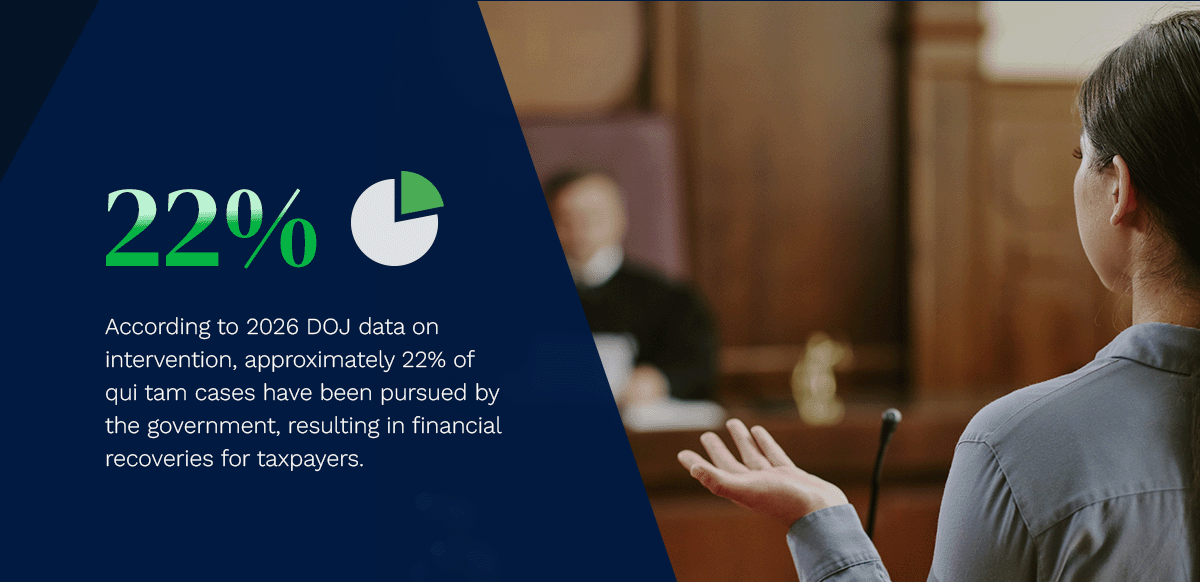
A decision to decline is not a ruling on the merits of the case, as it often reflects the government's resource constraints and enforcement priorities, as opposed to a judgment on the evidence. According to 2026 DOJ data on intervention, approximately 22% of qui tam cases have been pursued by the government, resulting in financial recoveries for taxpayers.
The government may also choose to intervene later upon a showing of good cause even after an initial decline.
When the Government Intervenes
When the DOJ intervenes, the government takes primary responsibility for prosecuting the case, though the relator remains a party throughout.
A relator's attorney continues to advocate for the relator's interests, including in settlement discussions, so the relator is not sidelined once the government steps in. The government typically leads settlement negotiations and court filings from this point forward, and intervened cases often resolve through settlement rather than trial.
If the case results in a recovery, the relator may receive between 15% and 25% of the proceeds, depending on the extent of the relator's contribution to the case. This provision rewards relators for evidence the government would not otherwise have, though the act's broader purpose remains protecting federal programs from fraud. Defendants found liable under the act can face treble damages and civil penalties for each false claim submitted, in addition to the underlying amount owed to the government.
In fiscal year 2025, qui tam suits specifically accounted for more than $5.3 billion in settlements and judgments, underscoring how substantial these recoveries can be.
When the Government Declines
A decision by the DOJ not to intervene can feel discouraging, but it does not mean a qui tam lawsuit has ended. As with the intervention decision, a decline typically reflects the government's own resource and priority assessment rather than a conclusion about the case's merits.
When the government declines to intervene, a relator may elect to proceed with the litigation independently. If the case succeeds, the relator's share of the recovery can increase to as much as 30% of the proceeds.
Declined qui tam matters have nonetheless produced more than $7.86 billion in settlements and judgments since 1986, demonstrating that these cases can still result in meaningful recoveries. The government also retains the ability to intervene later upon a showing of good cause, so a decline is not necessarily permanent. Readers interested in how these cases have played out can review recent False Claims Act outcomes for additional context.
Common Types of Qui Tam Lawsuits
Qui tam lawsuits can arise wherever fraud affects a federal program, but certain fact patterns appear more frequently than others.
Medicare and Medicaid Fraud
Healthcare fraud involving Medicare and Medicaid accounted for the largest share of total False Claims Act recoveries in fiscal year 2025. Common schemes include:
- Upcoding billing codes: Submitting a billing code for a higher level of service than what was actually provided to increase reimbursement.
- Billing for services never rendered: Charging federal programs for appointments, tests, or procedures that never took place.
- Paying illegal kickbacks: Compensating physicians for patient referrals or prescriptions in violation of federal anti-kickback law.
- Promoting off-label drug uses: Marketing a medication for uses the Food and Drug Administration has not approved.
- Falsifying patient diagnoses: Adding or altering diagnosis codes to trigger additional government payments.
Of the $6.8 billion the DOJ recovered under the False Claims Act in fiscal year 2025, more than $5.7 billion in recoveries related to healthcare matters, reflecting how significant this category has become. If you suspect Medicare and Medicaid fraud or fraud tied to improper pharmaceutical marketing practices, you can learn more on these specific fact patterns from our dedicated resources.
Defense Contractor Fraud
Defense contractor fraud represents another major category, with origins tracing to the law's earliest history. The False Claims Act was originally enacted in 1863 in response to defense contractor fraud committed against the Union Army during the Civil War, and the statute still applies to similar schemes today. Common violations include:
- Defective pricing: Providing the government with inaccurate cost or pricing data during contract negotiations.
- Misrepresenting product quality: Delivering goods or equipment that do not meet the specifications promised to the government.
- Violating the Truth in Negotiations Act: Failing to disclose accurate cost data as federal procurement law requires.
- Delivering substandard equipment: Supplying the military with goods that fail to meet contracted performance standards.
In 2024, aerospace and defense company Raytheon agreed to pay more than $950 million to resolve allegations that included defective pricing on government contracts, with $428 million of that total tied specifically to a False Claims Act settlement, and the relator who filed that qui tam lawsuit received an 18% share of the proceeds. If you have evidence of defense contractor fraud, review our resources to find additional detail on how these cases typically unfold.
Procurement Fraud
Procurement fraud overlaps with defense contracting but extends more broadly to any company that sells goods or services to the federal government. Common violations in this category include:
- Buy American Act misrepresentation: Falsely certifying that goods meet domestic sourcing requirements for federal contracts.
- GSA Multiple Award Schedule pricing fraud: Misrepresenting pricing or discount practices under General Services Administration contracts.
- Falsifying contractor qualifications: Misstating a company's certifications or past performance to win government work.
If you have witnessed signs of procurement fraud involving a federal vendor relationship, you can learn more about how these cases are evaluated and pursued in our resources.
Recent Qui Tam Case Outcomes
Examining recent qui tam case examples can help illustrate how the process plays out in practice, from the kind of evidence relators bring forward to the recoveries that can result.
- Kaiser Permanente, $556 million, healthcare, January 2026: Two former Kaiser Permanente employees, Ronda Osinek and James M. Taylor, M.D., filed qui tam lawsuits alleging that Kaiser affiliates submitted invalid Medicare Advantage diagnosis codes to inflate government payments. The DOJ intervened, resulting in a $556 million settlement figure, and the relators received approximately $95 million combined.
- Walgreens, up to $350 million, healthcare, April 2025: Former Walgreens employees filed qui tam lawsuits alleging the pharmacy chain submitted false claims to Medicare for opioid prescriptions filled in violation of federal law. The government intervened, and the settlement could reach up to $350 million total, with relators receiving a 17.25% share.
- Pfizer and Biohaven, approximately $60 million, pharmaceutical, January 2025: A former Biohaven sales representative, Patricia Frattasio, filed a qui tam lawsuit alleging the company paid illegal kickbacks to induce prescriptions of a migraine medication. Pfizer, which had since acquired Biohaven, agreed to resolve the allegations for nearly $60 million, and Frattasio received approximately $8.4 million.
These outcomes reflect a small sample of recent False Claims Act results, each shaped by the same procedural framework outlined above.
Who Can File a Qui Tam Lawsuit?
Not everyone who learns of fraud against the government qualifies to bring a qui tam lawsuit. Current and former employees, contractors, and even competitors with direct knowledge of fraudulent conduct can generally qualify as a qui tam relator, provided they bring original, non-public evidence to the case.
- First-to-file bar: If another relator has already filed a qui tam lawsuit based on the same underlying facts, a subsequent case addressing those same facts may be barred from proceeding.
- Public disclosure bar: If the allegations have already been publicly disclosed through government reports, litigation, or news coverage, a case may face restrictions unless the relator qualifies as an original source of the evidence.
- Statute of limitations: A qui tam lawsuit generally must be filed within six years of the violation, or within three years of when the government knew or should have known of it — whichever is later. However, the total time allowed cannot exceed 10 years from the violation itself.
The False Claims Act also includes anti-retaliation provisions under 31 U.S.C. § 3730(h), which protect relators who experience termination, demotion, or harassment because of their involvement in a qui tam lawsuit. Readers can learn more about these anti-retaliation legal protections and how they apply throughout a case.
Discuss Your Qui Tam Case With an Experienced Attorney
Qui tam cases involve detailed procedural requirements, strict filing deadlines, and a government decision point that can shape a case's trajectory. A prospective relator can request a free and confidential case review with Goldberg Kohn to discuss the evidence they have gathered and understand how the qui tam process may apply.
Goldberg Kohn's False Claims Act attorneys have represented relators across healthcare, defense contracting, and procurement fraud matters. The firm's qui tam practice began with a $334 million jury verdict, the largest jury award in the history of the False Claims Act and Illinois Whistleblower Reward and Protection Act at the time, though the case later settled for $225 million while an appeal was pending. That experience extends to matters the government has declined to pursue.
When the government decides not to intervene, Goldberg Kohn can continue litigating a case independently on the relator's behalf. Anyone preparing to file a whistleblower case can benefit from discussing their situation with an attorney first. If you're still weighing whether your evidence supports a claim, our resources can help you evaluate whether a case exists before any formal filing. If you are ready to discuss your situation, request a free and confidential case review today.